Vitamin C in Skincare — What It Does & How to Use It Right
Quick Answer
Vitamin C is the best-evidenced antioxidant in skincare. L-ascorbic acid is the potent, unstable form; derivatives are gentler and steadier but vary in how well they convert on skin.
Two things worth knowing. You can use it with niacinamide — that incompatibility is a myth from experiments where the two were heated together. And vitamin C with vitamin E and ferulic acid outperforms vitamin C alone, which is the most useful fact for choosing a product.
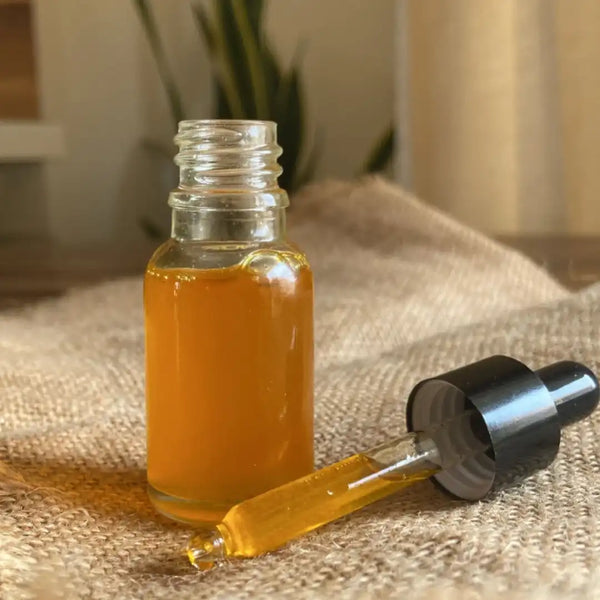
If your serum has turned yellow-orange or brown, it has oxidised — you are applying degraded product.
Vitamin C appears on every must-have list, and mostly deserves to. But the standard advice around it contains one widely repeated instruction that is simply wrong, and leaves out the finding that would actually help you choose a product.
What we'll cover
The Niacinamide Myth
You will have read that vitamin C and niacinamide cancel each other out and must never share a routine. It is one of the most repeated rules in skincare, and it is not correct.
Where the myth came from
Mid-twentieth-century work found that ascorbic acid and niacinamide can react to form a complex — nicotinyl ascorbate — which can turn a formulation yellow and was thought to reduce activity.
The detail that got lost in transmission: this required heating the two together. The reaction is negligible at the temperatures of a bathroom shelf or a human face.
Modern formulation practice reflects that. The two are combined in commercial products routinely, and there is no good reason to separate them in your own routine.
So use them together if you want to. If a combined product stings you, that is worth respecting — but it will be the low pH of the vitamin C rather than any interaction between the two ingredients.
This one is worth knowing because it is a good example of how skincare advice propagates. A real laboratory observation, stripped of the conditions that produced it, becomes a rule that millions of people follow unnecessarily.
The Combination That Actually Matters
If there is one thing to take from this article when choosing a product, it is this.
Vitamin C, vitamin E and ferulic acid
Research from Pinnell's group at Duke found that combining L-ascorbic acid with alpha-tocopherol and ferulic acid delivered greater photoprotection than L-ascorbic acid on its own — the three working together rather than merely coexisting.
Two things are happening. Vitamin E is fat-soluble while vitamin C is water-soluble, so together they cover both environments, and vitamin C helps regenerate vitamin E after it has done its work. Ferulic acid stabilises the formula, which addresses vitamin C's central weakness.
Practical upshot: when comparing products, a formula containing all three is generally a better proposition than a higher percentage of vitamin C alone.
It is also a useful corrective to how these products are marketed. The percentage on the front is the least informative number available — formulation, stabilisation and packaging determine far more of what you actually get.
L-Ascorbic Acid Versus Derivatives
| L-ascorbic acid | Derivatives | |
|---|---|---|
| Evidence | The form nearly all the research used | Less studied, and varies by derivative |
| Stability | Poor — degrades with light, air and water | Considerably better |
| pH | Needs low pH to penetrate — hence the sting | Work across a wider range, so gentler |
| Catch | May irritate; needs careful packaging | Must convert on skin, and conversion varies |
The derivative caveat nobody mentions
"Converts to vitamin C on the skin" is usually stated as though it were a solved problem. How efficiently that happens varies considerably between derivatives, and for some it is poor. A derivative is not automatically a gentler equivalent of L-ascorbic acid — it is a different ingredient with its own evidence, and some have much more behind them than others.
Which does not make derivatives a bad choice. A gentle product used daily for a year beats a potent one abandoned after a fortnight, and for reactive skin that trade is clearly worth making. Just do not assume equivalence.
How To Tell Yours Has Gone Off
Vitamin C is unusual among actives in giving you a visible expiry signal, and most people never learn to read it.
Watch the colour
A fresh L-ascorbic acid serum is clear or very pale. As it oxidises it turns yellow, then orange, then brown — that colour is the degradation product.
A distinctly orange or brown serum has largely stopped being vitamin C. It is unlikely to harm you, but you are applying an expensive placebo. Slight darkening near the end of a bottle is ordinary; a dramatic shift is not.
Which makes packaging a genuine buying criterion. Opaque or tinted glass, an airless pump or a tube — anything that limits light and air. A clear dropper bottle is working against the ingredient, and every use draws fresh air into the container.
Store it away from windowsills and steamy bathrooms, and use it within a reasonable period after opening rather than treating it as indefinite.


Choosing And Using It
- Prefer a formula with vitamin E and ferulic acid over a higher percentage of vitamin C alone. Better evidence, better stability.
- Judge the packaging before the percentage. Opaque, airless, sealed. A clear dropper bottle undermines whatever is inside it.
- Start every other day if you're new to it, and build up. Reactive skin should begin with a derivative rather than L-ascorbic acid at strength.
- Use it whenever suits you, morning or evening. Morning pairs sensibly with sunscreen; evening avoids competing with other steps.
- Combine freely with niacinamide. Separating them is unnecessary.
- Do separate it from strong exfoliating acids and retinoids — not because of any chemical conflict, but because stacking potent actives in one step is how irritation starts.
- Wear sunscreen regardless. An antioxidant supports skin against oxidative stress; it does not absorb or reflect UV and has no SPF.
Questions, Answered
The Bottom Line
You can use it with niacinamide — that rule came from a heated test tube. Look for vitamin C with vitamin E and ferulic acid in opaque packaging rather than chasing a higher percentage. And watch the colour: orange or brown means you're applying a placebo. Sunscreen regardless.
References
- Pullar JM, Carr AC, Vissers MCM. The roles of vitamin C in skin health. Nutrients. 2017;9(8):866.
- Telang PS. Vitamin C in dermatology. Indian Dermatology Online Journal. 2013;4(2):143–146.
- Lin FH, Lin JY, Gupta RD, et al. Ferulic acid stabilizes a solution of vitamins C and E and doubles its photoprotection of skin. Journal of Investigative Dermatology. 2005;125(4):826–832.
- Pinnell SR, Yang H, Omar M, et al. Topical L-ascorbic acid: percutaneous absorption studies. Dermatologic Surgery. 2001;27(2):137–142.
Note to editor: the regulatory codes previously listed as references 1 and 2 are compliance frameworks rather than scientific sources and now appear only in the disclaimer. Lin and Pinnell are added for the ferulic acid stabilisation and percutaneous absorption findings. The vitamin C / niacinamide incompatibility has been corrected — it was stated as fact in three places and is a myth deriving from experiments in which the two were heated together. Please verify before publication. And run a library-wide search for "does not currently" — this page carried the absence statement twice, as did the hyaluronic acid and trehalose pages; it is clearly built into this template.
© 2026 Boldpurity · For educational purposes only · Not to be reproduced without permission.