

Key Research Findings
- Published dermatology literature describes "sensitive skin" as a very common, largely self-reported state of heightened reactivity—not a fixed, unchangeable skin type
- Published research associates much skin sensitivity with a compromised or under-supported skin barrier and increased water loss
- Published literature distinguishes "sensitive" (innate reactivity) from "sensitised" (skin made reactive over time by triggers or over-use of actives)
- Published research indicates sensitivity often fluctuates with season, climate, hormones, stress, and product use—consistent with a condition, not a permanent type
- Published dermatology literature separates general reactivity from true allergic contact reactions, which involve the immune system and need professional assessment
- Published studies commonly discuss barrier support, trigger reduction, and simplifying routines as approaches that may reduce reactivity over time
- Published research indicates "for sensitive skin" on a label is not a regulated guarantee; the specific formulation matters more than the claim
- Published literature emphasises individual response varies, and patch testing new products is commonly discussed
In This Article
- Type vs Condition: Why the Difference Matters
- What "Sensitive Skin" Actually Describes
- Sensitive vs Sensitised vs Reactive vs Allergic
- The Barrier Connection
- Why Sensitivity Comes and Goes
- The "For Sensitive Skin" Label Myth
- The Boldpurity Calm-Support-Rebuild Framework
- A Gentle, Commonly Discussed Approach
- Common Myths About Sensitive Skin
- Frequently Asked Questions
Type vs Condition: Why the Difference Matters
Published dermatology literature draws a useful distinction between a skin type (a relatively stable baseline, such as how much oil skin tends to produce) and a skin condition (a changeable state influenced by environment, routine, and health). Published research indicates that framing something as a permanent "type" implies it cannot change, whereas a "condition" implies it can be influenced and supported. For more on this distinction, see our article on skin types vs skin conditions.
What "Sensitive Skin" Actually Describes
Published research describes "sensitive skin" as one of the most commonly self-reported skin complaints worldwide, characterised by sensations such as stinging, burning, tightness, itching, or visible redness in response to products or the environment. Published dermatology literature notes that it is largely defined by how skin responds rather than by a single measurable feature—which is part of why it behaves like a condition.
Published Research on Reactivity
Published dermatology literature indicates that sensitive skin often involves a lowered threshold for reacting to stimuli—so the same product or weather that another person tolerates may provoke discomfort. Published research links this heightened reactivity in many cases to barrier function and nerve-ending sensitivity in the upper skin, rather than to a fixed category of skin. Individual experience varies considerably.
Sensitive vs Sensitised vs Reactive vs Allergic
These words get used interchangeably, but published literature treats them as distinct—and the distinction changes what may help. For a related overview, see our guide on sensitive, reactive, allergic or intolerant skin.
| Term | What it means (published literature) | Typical drivers |
|---|---|---|
| Sensitive | Innate tendency to react easily | Barrier + nerve sensitivity; often longstanding |
| Sensitised | Skin made reactive over time | Over-exfoliation, over-use of actives, harsh routines |
| Reactive | Flares in response to specific triggers | Weather, heat, friction, specific products |
| Allergic | Immune-system reaction to a specific allergen | Needs professional diagnosis; not just "sensitivity" |
The Barrier Connection
Published research repeatedly links skin sensitivity to the state of the skin barrier. Published dermatology literature indicates that when the barrier is compromised, it allows more water to escape and more irritants to penetrate—both of which can raise reactivity. This is measurable in part through transepidermal water loss (TEWL).
Published Research on Barrier and Sensitivity
Published studies associate a well-supported barrier with lower reactivity, and a disrupted barrier with more stinging, tightness, and redness. Published literature commonly discusses that because the barrier can be supported, sensitivity linked to it can often be reduced—again pointing to a condition rather than a permanent type. Learn the warning signs in our article on the signs of a damaged skin barrier.
Why Sensitivity Comes and Goes
Published research indicates that skin sensitivity commonly fluctuates—worse in winter or dry air, after over-exfoliation, during hormonal shifts, or in periods of stress, and calmer at other times. Published dermatology literature notes that a fixed skin type would not switch on and off like this; the fact that it fluctuates is itself evidence that sensitivity behaves like a condition responding to circumstances.
The "For Sensitive Skin" Label Myth
Published commentary indicates that "for sensitive skin" is a marketing description, not a regulated or standardised guarantee. Published literature notes there is no single legal definition a product must meet to make that claim, and that products labelled this way still vary widely in formulation. This echoes the pattern in our natural and organic marketing myth article.
The Boldpurity Calm-Support-Rebuild Framework
Published dermatology literature commonly discusses a staged approach to reactive skin. We summarise it as a simple, named framework.
The Calm–Support–Rebuild Framework
- Calm — reduce triggers first: pause strong actives and exfoliation, avoid known irritants, simplify the routine.
- Support — favour gentle, barrier-supporting hydration (humectants and soothing ingredients) to reduce water loss.
- Rebuild — reintroduce anything active slowly, one at a time, only once skin feels settled.
This is an educational framework reflecting commonly discussed practice, not a prescriptive regimen. Individual response varies, and persistent reactions warrant professional advice.
A Gentle, Commonly Discussed Approach
For skin going through a reactive phase, published dermatology literature commonly discusses the following, consistent with the framework above. See also our dry, sensitive skin guide and the sensitive skin guide.
Commonly discussed steps for a reactive phase
- Simplify. Pare back to a gentle cleanser, a barrier-supporting moisturiser, and daytime sun protection.
- Pause actives. Temporarily stop exfoliating acids, retinoids, and strong vitamin C while skin settles.
- Support hydration. Use humectant- and soothing-focused hydration to help reduce water loss.
- Patch test anything new on a small area for a few days before full use.
- Reintroduce slowly. Add one active back at a time, spaced out, watching how skin responds.
- Seek advice if reactions are persistent, severe, or spreading.
A commonly discussed approach; individual response varies.
The Boldpurity Science Team's view
In our view, the "sensitive skin type" label does more harm than good. It tells people their skin is permanently fragile, which often leads them to either avoid everything out of fear, or over-buy "gentle" products that don't address what's actually driving the reactivity. We think the more empowering—and more accurate—message is that most sensitivity is a state the skin is in, not a cage it's locked in. Find the triggers, support the barrier, and reactive skin can often become a lot calmer than the label suggests.
— An editorial opinion from the Boldpurity Science Team, offered for discussion. Individual response varies.
Common Myths About Sensitive Skin
Published dermatology literature describes most sensitivity as a changeable condition linked to barrier status, triggers, and environment, rather than a fixed type. Published research notes it commonly fluctuates over time.
Published literature distinguishes general reactivity from a true allergic reaction, which involves the immune system and a specific allergen. Published dermatology literature indicates suspected allergy needs professional assessment.
Published commentary indicates the phrase is unregulated marketing, not a fixed standard. Published literature notes such products vary widely; formulation and your own patch test matter more than the claim.
Published research indicates skin can become "sensitised" through over-exfoliation or harsh routines, and often settles with a gentler approach. Published dermatology literature frames much reactivity as reversible.
Published dermatology literature suggests many people with reactive skin can tolerate gentle actives once the barrier is supported and actives are introduced slowly. Published research emphasises individual tolerance varies.
Published research indicates that adding more products can increase exposure to potential triggers. Published dermatology literature commonly discusses simplifying the routine first, then supporting the barrier.
Frequently Asked Questions
Explore Boldpurity
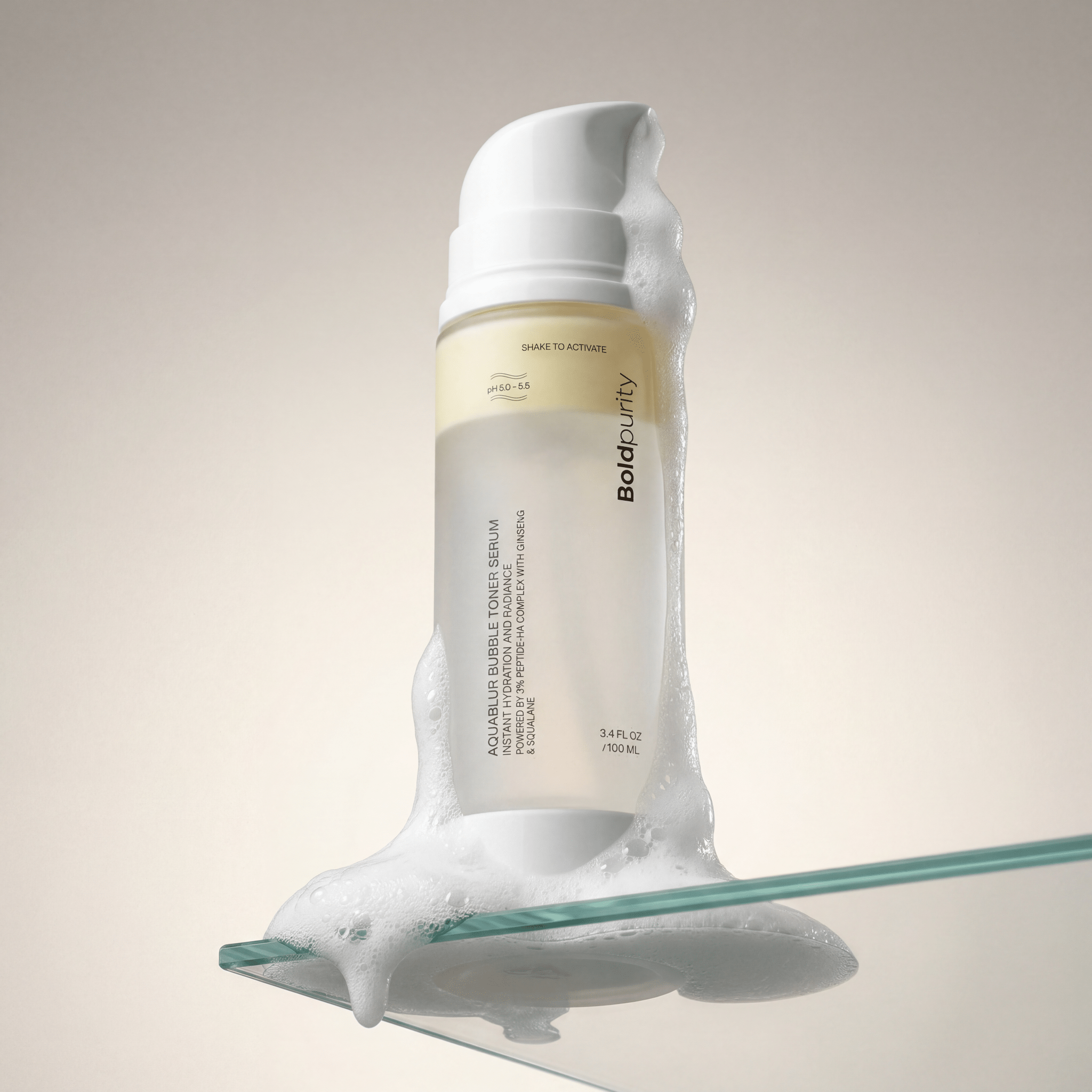
A lightweight, hydration-focused toner-serum with multi-molecular hyaluronic acid, peptides, and squalane — formulated to support comfortable, hydrated, calm-looking skin. A gentle option to consider while keeping a reactive-phase routine simple. Supports the appearance of hydrated skin; no therapeutic claims.
Discover AquaBlur™References
- Berardesca, E., Farage, M., & Maibach, H. (2013). Sensitive skin: An overview. International Journal of Cosmetic Science, 35(1), 2–8.
- Farage, M. A. (2019). The prevalence of sensitive skin. Frontiers in Medicine, 6, 98.
- Misery, L., Ständer, S., Szepietowski, J. C., et al. (2017). Definition of sensitive skin: An expert position paper. Acta Dermato-Venereologica, 97(1), 4–6.
- Richters, R., Falcone, D., Uzunbajakava, N. E., et al. (2015). What is sensitive skin? A systematic literature review of objective measurements. Skin Pharmacology and Physiology, 28(2), 75–83.
- Standard, A., et al. (2020). Sensitive skin syndrome: Mechanisms and management. Clinical, Cosmetic and Investigational Dermatology, 13, 703–713.
- Rawlings, A. V., & Harding, C. R. (2004). Moisturization and skin barrier function. Dermatologic Therapy, 17(S1), 43–48.
- Del Rosso, J. Q., & Levin, J. (2011). The clinical relevance of maintaining the functional integrity of the stratum corneum. Journal of Clinical and Aesthetic Dermatology, 4(9), 22–42.
- Lev-Tov, H., & Maibach, H. I. (2012). The sensitive skin syndrome. Indian Journal of Dermatology, 57(6), 419–423.
- Pons-Guiraud, A. (2004). Sensitive skin: A complex and multifactorial syndrome. Journal of Cosmetic Dermatology, 3(3), 145–148.
- Farage, M. A., & Maibach, H. I. (2010). Sensitive skin: Closing in on a physiological cause. Contact Dermatitis, 62(3), 137–149.
- Muizzuddin, N., Marenus, K. D., & Maes, D. H. (1998). Factors defining sensitive skin and its treatment. American Journal of Contact Dermatitis, 9(3), 170–175.
- Draelos, Z. D. (2018). The science behind skin care: Moisturizers. Journal of Cosmetic Dermatology, 17(2), 138–144.
- Fluhr, J. W., Darlenski, R., & Surber, C. (2008). Glycerol and the skin: Holistic approach to its origin and functions. British Journal of Dermatology, 159(1), 23–34.
- Kim, E. J., et al. (2016). Barrier-based approaches to sensitive skin management. Journal of Cosmetic Dermatology, 15(4), 389–395.
- Chen, W., et al. (2020). Environmental and lifestyle factors in skin sensitivity. Journal of the European Academy of Dermatology, 34(9), 1934–1943.
- Purnamawati, S., Indrastuti, N., Danarti, R., & Saefudin, T. (2017). The role of moisturizers in addressing various kinds of dermatitis: A review. Clinical Medicine & Research, 15(3–4), 75–87.
