

Key Research Findings
- Published physiology indicates adequate hydration is important for overall health, and that severe dehydration can visibly affect skin
- Published research indicates that in already-hydrated people, drinking extra water has limited direct evidence for improving skin hydration or appearance
- Published dermatology literature indicates skin's water content is governed largely by the skin barrier and its water-holding components, not by fluid intake alone
- Published research indicates some modest skin-hydration effects appear mainly in people who started with low water intake
- Published dermatology literature indicates topical humectants and occlusives influence skin hydration more directly than drinking water does
- Published research indicates the "8 glasses a day for glowing skin" rule is not a specific, evidence-based skincare prescription
- Published literature indicates over-drinking water well beyond thirst offers no extra skin benefit and, in extreme cases, is not harmless
- Published research emphasises individual needs vary with body, climate, and activity; drink to meet your needs, not to "treat" skin
In This Article
- The Claim vs the Biology
- Dehydration vs Normal Hydration
- What the Evidence Actually Shows
- Why the Barrier Matters More Than Intake
- The "8 Glasses for Glowing Skin" Myth
- Internal Hydration vs Topical Hydration
- The Boldpurity Drink-Enough-Hydrate-Topically Framework
- What Actually Supports Skin Hydration
- Common Water & Skin Myths
- Frequently Asked Questions
The Claim vs the Biology
The popular claim is simple: drink more water, get clearer, plumper, glowing skin. Published physiology complicates it. Water you drink is absorbed by the gut, distributed through the bloodstream, and regulated tightly by the kidneys — it does not travel straight to the skin's surface to hydrate it like watering a plant. Published dermatology literature indicates the water content of the outer skin is controlled mostly by the skin barrier and its water-holding components, not by the last glass you drank.
Dehydration vs Normal Hydration
Published research draws an important distinction. Genuine dehydration — when the body lacks adequate fluid — can reduce skin turgor and make skin look and feel worse; correcting it helps. But published dermatology literature indicates that once you are normally hydrated, adding still more water does not keep linearly improving the skin, because the body maintains fluid balance within a tight range and excretes the excess.
Published Research on Baseline Matters
Published research indicates the studies that show a skin-hydration benefit from increased water intake tend to involve people who began with low intake — for whom topping up makes a difference. Published dermatology literature indicates this does not translate to a benefit for someone already drinking enough drinking even more. Baseline is everything: fixing a deficit helps; exceeding your needs mostly means more trips to the bathroom.
What the Evidence Actually Shows
Published research on water intake and skin is limited and mixed. Some studies report modest changes in skin hydration measurements with increased intake — often concentrated in low-intake individuals — while showing little consistent effect on visible "glow," wrinkles, or oiliness in already-hydrated people. Published dermatology literature indicates the honest summary is: adequate hydration supports normal skin function, but extra water is not a proven skincare intervention.
Why the Barrier Matters More Than Intake
Published dermatology literature indicates that how hydrated your skin looks and feels depends largely on how well the barrier holds water in — that is, on limiting transepidermal water loss — and on the skin's own water-binding natural moisturizing factors. Published research indicates a compromised barrier loses water regardless of how much you drink, which is why barrier care and topical hydration are the more direct levers.
The "8 Glasses for Glowing Skin" Myth
Published commentary indicates the "8 glasses a day" figure is a rough popular rule, not a precise, evidence-based skincare prescription — and that fluid needs vary widely by body size, climate, activity, and diet (food contributes water too). Published research indicates attaching a specific skin-glow promise to a fixed number of glasses is not supported. Drink to meet your needs and thirst; the magic number for radiant skin doesn't exist.
Internal Hydration vs Topical Hydration
The two are often confused. Here's how they differ for skin:
| Drinking water (internal) | Topical hydration (skincare) | |
|---|---|---|
| What it does | Maintains whole-body fluid balance | Adds/holds water at the skin surface |
| Effect on skin surface | Indirect; limited once hydrated | Direct and measurable |
| Fixes a compromised barrier? | No | Supports it (humectants + occlusives) |
| Best for | Health; correcting dehydration | Skin comfort, plumpness, appearance |
| Overdoing it helps? | No | No — balance, not excess |
The Boldpurity Drink-Enough-Hydrate-Topically Framework
Published dermatology literature points to a simple, honest approach. We summarise it as a named framework.
The Drink-Enough–Hydrate-Topically Framework
- Drink enough — meet your body's needs and thirst for overall health; don't force excess for "skin."
- Hydrate topically — use humectants and a moisturiser to add and hold water at the skin surface.
- Protect the barrier — a healthy barrier keeps that water in, which matters more than intake volume.
This is an educational framework, not medical or nutritional advice. Individual fluid needs and skin response vary.
What Actually Supports Skin Hydration
Published dermatology literature commonly discusses the following for hydrated-looking, comfortable skin — with water intake as one supporting part, not the star.
Commonly discussed steps
- Stay adequately hydrated — for health; you don't need to force glasses beyond your needs.
- Apply humectants to damp skin — ingredients that bind water at the surface, then seal them in.
- Use a moisturiser — to limit water loss and keep the barrier comfortable.
- Support the barrier — gentle cleansing, avoid over-exfoliation, so skin holds water well.
- Mind the environment — dry air, AC, heat, and hard water affect skin water loss.
- Set realistic expectations — hydration helps comfort and plumpness, not a total transformation.
A commonly discussed approach; individual response varies.
The Boldpurity Science Team's view
In our view, "drink water for glowing skin" is a rare myth that's mostly harmless — and still worth correcting. Harmless, because staying hydrated is genuinely good for you, so the advice rarely hurts. Worth correcting, because it sells people a fantasy that a water bottle can replace skincare, and leaves them puzzled when eight glasses a day don't fix dry, dull, or breakout-prone skin. The honest version is less catchy: drink enough to feel well, and treat your skin's surface with actual topical hydration and barrier care. Your kidneys are very good at their job — they're not going to route your third litre to your cheeks.
— An editorial opinion from the Boldpurity Science Team, offered for discussion. Individual response varies.
Common Water & Skin Myths
Published research indicates that in already-hydrated people, extra water has limited direct effect on skin appearance. Published dermatology literature indicates skin surface hydration depends mostly on the barrier and topical care, not intake volume.
Published dermatology literature indicates dry skin is usually about barrier function and water loss, not fluid intake. Published research indicates you can be well-hydrated internally and still have dry-feeling skin from a compromised barrier.
Published commentary indicates "8 glasses" is a rough rule, not a skin prescription, and needs vary by body, climate, activity, and diet. Published research indicates no fixed number is tied to skin glow.
Published dermatology literature indicates internal hydration and topical hydration do different jobs; water intake doesn't add or hold water at the skin surface the way humectants and moisturisers do. Published research indicates they are complementary, not interchangeable.
Published research indicates benefit plateaus once you're adequately hydrated, and that drinking well beyond thirst gives no extra skin benefit — and in extreme cases is not harmless. Published literature indicates adequate, not maximal, is the goal.
Published dermatology literature does not support drinking water as an acne treatment; acne is driven by oil, follicles, bacteria, and inflammation. Published research indicates hydration supports general skin function but isn't an acne remedy.
Frequently Asked Questions
Explore Boldpurity
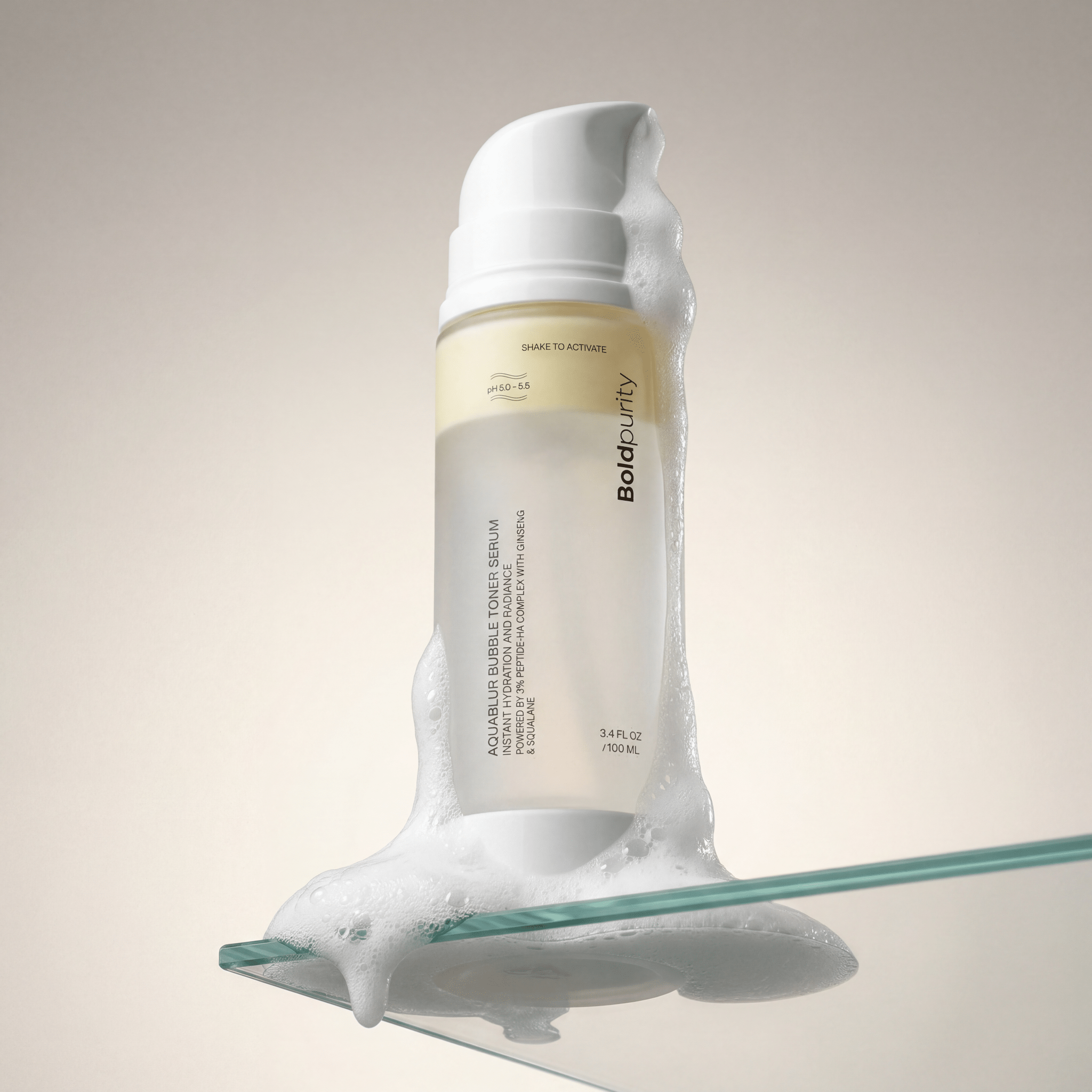
Since skin hydration happens at the surface, AquaBlur™ delivers it where drinking water can't reach — multi-molecular hyaluronic acid, peptides, and squalane to add and help hold water in the skin. The topical half of "hydration, inside and out." Supports the appearance of hydrated, comfortable skin; no therapeutic claims.
Discover AquaBlur™References
- Palma, L., Marques, L. T., Bujan, J., & Rodrigues, L. M. (2015). Dietary water affects human skin hydration and biomechanics. Clinical, Cosmetic and Investigational Dermatology, 8, 413–421.
- Akdeniz, M., Tomova-Simitchieva, T., Dobos, G., et al. (2018). Does dietary fluid intake affect skin hydration in healthy humans? A systematic literature review. Skin Research and Technology, 24(3), 459–465.
- Popkin, B. M., D'Anci, K. E., & Rosenberg, I. H. (2010). Water, hydration, and health. Nutrition Reviews, 68(8), 439–458.
- Wolf, R., Wolf, D., Rudikoff, D., & Parish, L. C. (2010). Nutrition and water: Drinking eight glasses of water a day ensures proper skin hydration—myth or reality? Clinics in Dermatology, 28(4), 380–383.
- Verdier-Sévrain, S., & Bonté, F. (2007). Skin hydration: A review on its molecular mechanisms. Journal of Cosmetic Dermatology, 6(2), 75–82.
- Rawlings, A. V., & Harding, C. R. (2004). Moisturization and skin barrier function. Dermatologic Therapy, 17(S1), 43–48.
- Rawlings, A. V., Scott, I. R., Harding, C. R., & Bowser, P. A. (1994). Stratum corneum moisturization at the molecular level. Journal of Investigative Dermatology, 103(5), 731–741.
- Fluhr, J. W., Darlenski, R., & Surber, C. (2008). Glycerol and the skin. British Journal of Dermatology, 159(1), 23–34.
- Elias, P. M. (2005). Stratum corneum defensive functions: An integrated view. Journal of Investigative Dermatology, 125(2), 183–200.
- Del Rosso, J. Q., & Levin, J. (2011). The clinical relevance of maintaining the functional integrity of the stratum corneum. Journal of Clinical and Aesthetic Dermatology, 4(9), 22–42.
- Sawka, M. N., Cheuvront, S. N., & Carter, R. (2005). Human water needs. Nutrition Reviews, 63(6), S30–S39.
- Institute of Medicine. (2005). Dietary reference intakes for water, potassium, sodium, chloride, and sulfate. National Academies Press.
- Draelos, Z. D. (2018). The science behind skin care: Moisturizers. Journal of Cosmetic Dermatology, 17(2), 138–144.
- Purnamawati, S., Indrastuti, N., Danarti, R., & Saefudin, T. (2017). The role of moisturizers in addressing various kinds of dermatitis. Clinical Medicine & Research, 15(3–4), 75–87.
- Bak, A., et al. (2018). Fluid intake and skin physiology: A critical appraisal. International Journal of Cosmetic Science, 40(5), 435–443.
- Farage, M. A., Miller, K. W., Elsner, P., & Maibach, H. I. (2008). Intrinsic and extrinsic factors in skin ageing. International Journal of Cosmetic Science, 30(2), 87–95.
