

Key Research Findings
- Published research indicates "peptides" is a broad umbrella; evidence quality varies significantly by the specific peptide, not the category as a whole
- Published dermatology literature describes peptides as short chains of amino acids that can act as messengers or signals in the skin
- Published research indicates peptides are relatively large, hydrophilic molecules, so penetration and formulation are major determinants of whether they can act
- Published studies report some signal peptides and neuropeptides are associated with the appearance of firmer, smoother skin over time, with mixed and evolving evidence
- Published dermatology literature indicates delivery systems and vehicle matter as much as the peptide itself — a peptide that cannot reach its target cannot signal
- Published research indicates peptide results are gradual and subtle rather than dramatic; realistic expectations matter
- Published commentary indicates the word "peptides" on a label is not a guarantee of efficacy; type, concentration, and formulation all matter
- Published literature emphasises individual response varies; peptides are one supporting option, not a standalone miracle
In This Article
- What Peptides Actually Are
- The Delivery Problem: Why Size Matters
- The Main Types of Skincare Peptides
- What the Evidence Does and Doesn't Support
- Peptides vs Retinoids vs Vitamin C
- The "Contains Peptides" Label Myth
- The Boldpurity Type-Dose-Delivery Framework
- How to Use Peptides, Per Published Science
- Common Myths About Peptides
- Frequently Asked Questions
What Peptides Actually Are
Published research describes peptides as short chains of amino acids — the same building blocks that make up proteins such as collagen and elastin. Published dermatology literature indicates that in skincare, certain peptides are investigated for their ability to act as messengers: signalling skin cells, in theory, to behave in particular ways. For the full ingredient breakdown, see our guide on peptides in skincare.
The Delivery Problem: Why Size Matters
Published research indicates the single biggest reason a peptide product may under-deliver is penetration. Peptides are relatively large and water-loving molecules, and published dermatology literature notes that the skin barrier is specifically built to keep large, water-loving molecules out. A peptide that stays on the surface cannot signal cells deeper down.
Published Research on Peptides and Penetration
Published dermatology literature indicates that formulation strategies — such as making peptides more lipid-compatible, or using delivery systems — are used to try to improve how peptides reach their target. Published research indicates this is why two products with the "same" peptide can perform very differently: the deciding factor is often the delivery, not the ingredient name. This is the same barrier principle discussed in our skin barrier and spicule delivery articles.
The Main Types of Skincare Peptides
Published dermatology literature groups cosmetic peptides into broad functional categories. Evidence differs across them:
| Type | What it's investigated to do (published research) | Examples |
|---|---|---|
| Signal peptides | May signal support for the skin's own collagen-related processes | Palmitoyl peptides, oligopeptides |
| Neurotransmitter-inhibiting ("neuropeptides") | Investigated for the appearance of relaxed expression lines | Argireline (acetyl hexapeptide-8) |
| Carrier peptides | Investigated to deliver trace elements involved in skin processes | Copper tripeptide |
| Enzyme-inhibiting peptides | Investigated to slow breakdown of skin structural proteins | Various plant-derived peptides |
What the Evidence Does and Doesn't Support
Published research reports that some peptides — particularly certain signal and neuropeptides — are associated with improvements in the appearance of firmness, smoothness, or fine lines in some studies. Published dermatology literature also notes that much of this evidence comes from small studies, in-vitro work, or manufacturer-linked research, so it should be read with appropriate caution.
Evidence Review: A Balanced Read
Reviewing the published literature, a consistent pattern emerges: peptides are a legitimate, promising category with genuine mechanistic rationale, but the evidence is uneven, effects are described as gradual and modest, and study quality varies. Published research frames peptides as a reasonable supporting ingredient rather than a proven standalone treatment. This is an evidence synthesis, not a Boldpurity claim; findings are attributed to the cited studies, and individual response varies.
Peptides are often discussed alongside the skin's own structural proteins — for the biology, see collagen vs elastin.
05 —Peptides vs Retinoids vs Vitamin C
People often ask whether peptides "beat" retinoids or vitamin C. Published dermatology literature treats them as different tools with different evidence bases, not direct competitors:
| Ingredient | How it's understood to work | Evidence base & profile |
|---|---|---|
| Peptides | Signal/messenger roles; delivery-dependent | Promising but uneven; generally gentle; gradual |
| Retinoids | Interact with skin-cell receptors to influence renewal | Stronger evidence base; can cause irritation; gradual |
| Vitamin C | Antioxidant; role in collagen-related processes | Reasonable evidence; stability-dependent |
Published research indicates a common reason people prefer peptides is tolerability — they are generally gentle. See our retinoids comparison and vitamin C guide. Suitability depends on individual skin characteristics.
06 —The "Contains Peptides" Label Myth
Published commentary indicates that "with peptides" on a label tells you almost nothing on its own. Published research indicates what matters is which peptide, at what concentration, in what formulation, and with what delivery. A product can technically "contain peptides" at a level, or in a vehicle, that makes meaningful action unlikely.
The Boldpurity Type-Dose-Delivery Framework
Published dermatology literature points to three things that determine whether a peptide product can do anything. We summarise them as a simple, named framework.
The Type–Dose–Delivery Framework
- Type — which specific peptide is it, and what does the evidence for that peptide actually show?
- Dose — is it present at a level consistent with the studies, not just a trace "label sprinkle"?
- Delivery — is the formulation designed to help the peptide penetrate, rather than sit on the surface?
This is an educational framework for evaluating claims, not a prescriptive regimen. Individual response varies.
How to Use Peptides, Per Published Science
Published dermatology literature commonly discusses the following for getting the most from peptide products, consistent with the framework above.
Commonly discussed peptide-use principles
- Set realistic expectations. Published research describes peptide benefits as gradual and modest, over weeks to months, not overnight.
- Apply to clean, prepped skin so nothing blocks contact; a supported barrier is commonly discussed.
- Be consistent. Published literature indicates signal-type ingredients need regular, ongoing use.
- Pair sensibly. Peptides are generally gentle and commonly combined with hydration and sun protection.
- Judge the product, not the buzzword — use the Type-Dose-Delivery questions above.
A commonly discussed approach; individual response varies, and timelines differ between individuals.
The Boldpurity Science Team's view
In our view, peptides are neither the miracle the marketing suggests nor the scam the sceptics claim — and the truth is more useful than either. The interesting story with peptides isn't the ingredient, it's the delivery: a well-chosen peptide in a formula that can't get it into the skin is just an expensive label. That's why we think the smartest question a shopper can ask isn't "does it have peptides?" but "what's actually getting these peptides where they need to go?" Delivery is the part the industry under-explains — and the part that most determines whether a peptide product is worth it.
— An editorial opinion from the Boldpurity Science Team, offered for discussion. Individual response varies.
Common Myths About Peptides
Published research indicates "peptides" is a broad category with evidence that varies sharply by the specific peptide. Published dermatology literature notes some have supporting studies while others have limited data. The category as a whole is not uniformly "proven".
Published research indicates type, dose, formulation, and delivery all determine whether a peptide can act. Published commentary notes a product can contain peptides at a trace level or in a vehicle that limits penetration.
Published research indicates topical neuropeptides are investigated for the appearance of softened expression lines, but published dermatology literature is clear they do not replicate injectable procedures. The "Botox in a bottle" framing overstates the evidence.
Published research describes peptide effects as gradual and modest, building over weeks to months. Published dermatology literature indicates dramatic overnight change is not what the evidence supports.
Published research indicates formulation and delivery matter more than piling in many peptides. Published commentary notes long "peptide cocktail" lists can be marketing, with each present at token levels.
Published dermatology literature treats peptides as one supporting tool among several, with retinoids having a stronger evidence base for renewal. Published research frames them as complementary, not replacements.
Frequently Asked Questions
Explore Boldpurity
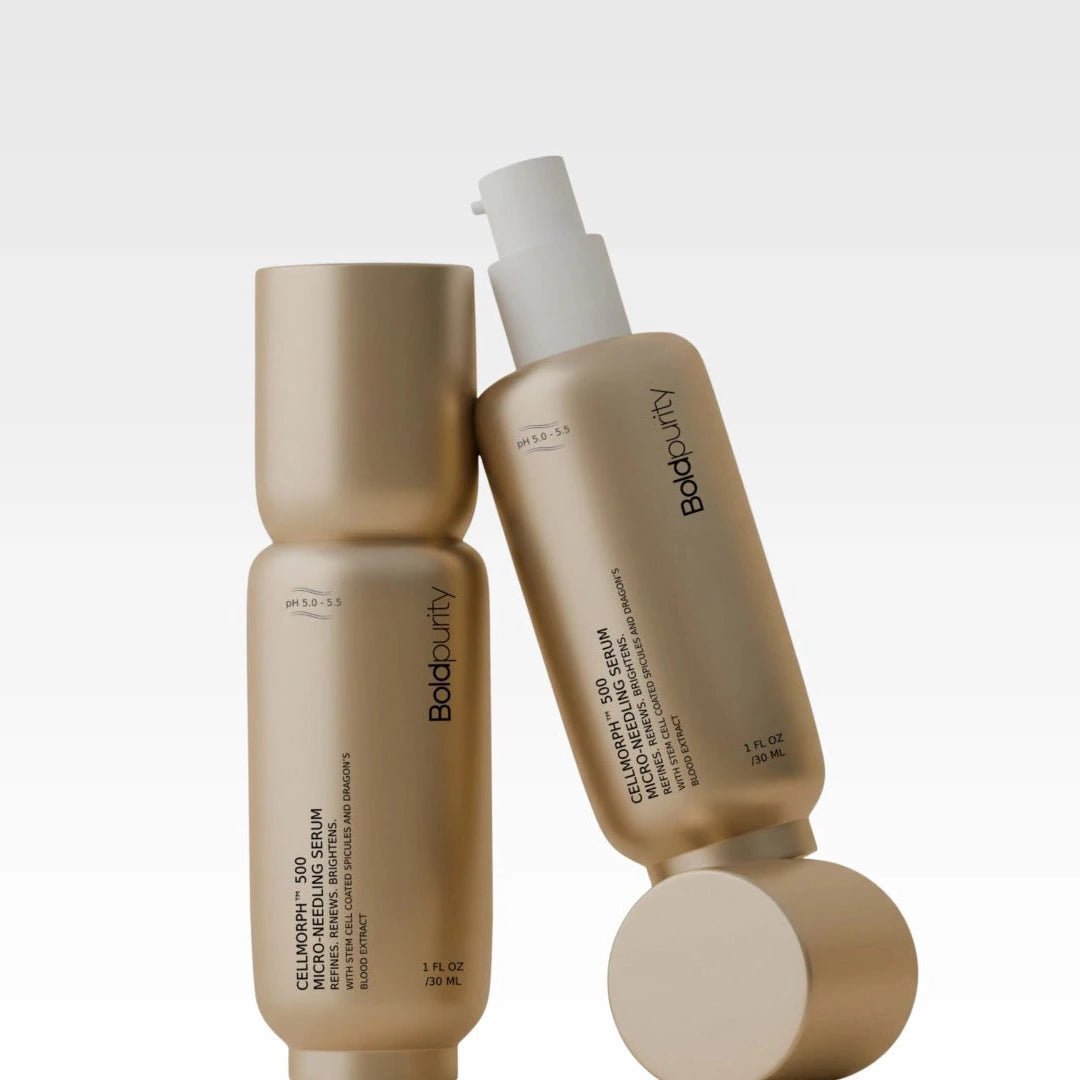
Since delivery is what decides whether peptides can act, CellMorph™ 500 uses apple stem cell-coated spicules to create surface microchannels — designed to support deeper delivery of its peptide and elastin complex. Supports the appearance of smoother texture and a more even-looking tone; no therapeutic claims.
Discover CellMorph™ 500References
- Schagen, S. K. (2017). Topical peptide treatments with effective anti-aging results. Cosmetics, 4(2), 16.
- Gorouhi, F., & Maibach, H. I. (2009). Role of topical peptides in preventing or treating aged skin. International Journal of Cosmetic Science, 31(5), 327–345.
- Lupo, M. P., & Cole, A. L. (2007). Cosmeceutical peptides. Dermatologic Therapy, 20(5), 343–349.
- Bos, J. D., & Meinardi, M. M. (2000). The 500 Dalton rule for the skin penetration of chemical compounds and drugs. Experimental Dermatology, 9(3), 165–169.
- Reddy, B., Jow, T., & Hantash, B. M. (2012). Bioactive oligopeptides in dermatology. Experimental Dermatology, 21(8), 563–568.
- Blanes-Mira, C., Clemente, J., Jodas, G., et al. (2002). A synthetic hexapeptide (Argireline) with antiwrinkle activity. International Journal of Cosmetic Science, 24(5), 303–310.
- Robinson, L. R., Fitzgerald, N. C., Doughty, D. G., et al. (2005). Topical palmitoyl pentapeptide provides improvement in photoaged human facial skin. International Journal of Cosmetic Science, 27(3), 155–160.
- Pickart, L., & Margolina, A. (2018). Regenerative and protective actions of the GHK-Cu peptide. International Journal of Molecular Sciences, 19(7), 1987.
- Fields, K., Falla, T. J., Rodan, K., & Bush, L. (2009). Bioactive peptides: Signaling the future. Journal of Cosmetic Dermatology, 8(1), 8–13.
- Draelos, Z. D. (2015). Cosmeceuticals: What's real, what's not. Dermatologic Clinics, 33(4), 715–724.
- Zhang, L., & Falla, T. J. (2009). Cosmeceuticals and peptides. Clinics in Dermatology, 27(5), 485–494.
- Errante, F., Ledwoń, P., Latajka, R., et al. (2020). Cosmeceutical peptides in the framework of sustainable wellness. Frontiers in Chemistry, 8, 572923.
- Jeong, S., Yoon, S., Kim, S., et al. (2019). Anti-wrinkle benefits of peptides. International Journal of Molecular Sciences, 21(1), 73.
- Wang, F., Garza, L. A., Kang, S., et al. (2007). In vivo stimulation of de novo collagen production. Archives of Dermatology, 143(2), 155–163.
- Choi, Y. L., et al. (2014). Enhanced skin delivery of peptides via formulation strategies. Journal of Cosmetic Dermatology, 13(2), 145–152.
- Pai, V. V., Bhandari, P., & Shukla, P. (2017). Topical peptides as cosmeceuticals. Indian Journal of Dermatology, Venereology and Leprology, 83(1), 9–18.
