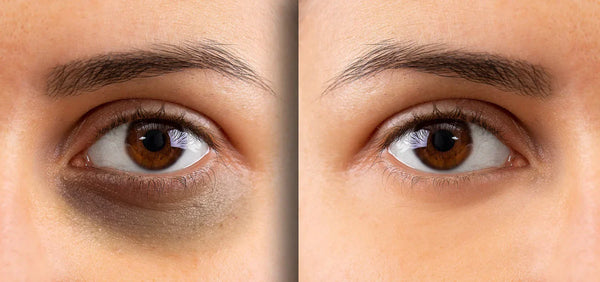
Does Draining the Under-Eyes Really Reduce Puffiness & Dark Circles?
Massage, gua sha, jade rollers — "draining" the under-eyes is everywhere. Does it work? The honest answer: there's no clinical proof it does.
It may give a brief de-puffed look for fluid puffiness — but does nothing for pigmented or structural circles.
Dark circles aren't all the same. Here's the real breakdown — and a gentle, honest approach.
This article is for educational purposes only and is not medical advice. It relates to the appearance and feel of the skin. Be gentle around the delicate eye area; see a doctor for persistent puffiness, pain, or sudden changes.
"Draining" the under-eyes with massage, gua sha, or a jade roller is hugely popular — but no clinical study has shown it actually reduces dark circles or puffiness. Gentle massage may give a brief, temporary de-puffed look for fluid-type puffiness, but it's not a proven or lasting fix — and it does nothing for pigmented or structural under-eye concerns, which have entirely different causes. Dark circles come in several types (vascular, pigmented, structural) and bags can be fluid or fat, so no single trick works for all. The honest basics: sleep, less salt, gentle skincare, and daily SPF — and if you enjoy a roller, keep it feather-light on this delicate skin.
- No clinical study has shown draining/massage reduces dark circles or under-eye bags.
- It may briefly improve the look of fluid puffiness — temporary, not proven, not lasting.
- It does nothing for pigmented or structural circles, which have different causes.
- Dark circles = vascular / pigmented / structural; bags = fluid or fat. No one fix suits all.
- The under-eye area is ~4× thinner — if you massage, keep pressure very light.
- Honest basics: sleep, less salt, gentle care, daily SPF; pronounced concerns → a doctor.
Few beauty rituals feel as satisfying as gliding a cold roller under tired eyes. But between the gua sha tutorials and "lymphatic drainage" claims, it's fair to ask: does any of it actually reduce dark circles and puffiness — or does it just feel nice? Here's the honest picture, starting with why under-eyes are so revealing in the first place.
Why the Under-Eye Area Shows Everything
The skin under your eyes is exceptionally thin and delicate — averaging around 0.5 mm, versus roughly 2 mm elsewhere on the face. That thinness is why the tiny blood vessels and fluid shifts underneath show up so readily as shadows and swelling. Sleep, stress, a salty meal, and hormonal changes can all make things look worse by affecting circulation and fluid balance — which is exactly why the area is so responsive to a bad night.
The Different Types of Circles & Bags
Here's the crucial point most "one trick" advice misses: dark circles and bags aren't a single thing. They have different causes — and that's why nothing works for all of them.
| Type | Cause | Look |
|---|---|---|
| Vascular circles | Blood pooling in tiny vessels, slowed return, seen through thin skin | Bluish / purplish tint |
| Pigmented circles | Appearance of localised extra melanin | Browner shade |
| Structural "shadows" | Loss of volume & skin laxity with age creating a hollow | Shadowing, not true colour |
| Fluid puffiness | Fluid gathering under the eyes (salt, sleep, fatigue) | Soft, temporary swelling |
| Fat pockets | Loosening of tissue holding orbital fat | Firmer, more permanent swelling |
Only fluid puffiness and, in theory, vascular circles relate to circulation and fluid — the things massage could plausibly touch. Pigmented circles (appearance of extra melanin) and structural shadows and fat pockets don't move with drainage at all. So knowing your type is the first honest step.
Does Draining Actually Work?
"Lymphatic drainage is a real, well-documented medical technique for conditions like lymphedema. But applying it to under-eye bags? No clinical study has actually tested that — so the benefit stays hypothetical."
Boldpurity Science TeamThe theory is reasonable: gentle massage might nudge fluid along and support circulation, which could ease fluid puffiness or vascular shadows. But reasonable-in-theory isn't the same as proven. To date, no clinical study has evaluated whether draining or massaging the under-eye area actually reduces dark circles or puffiness.
So the honest verdict: a gentle roll or massage may give a brief, temporary de-puffed look for fluid puffiness (and it's pleasant) — but it's not a proven or lasting fix, and it does nothing for pigmented, structural, or fatty under-eye concerns.
If You Do Massage: Do It Gently
If you enjoy a roller or gua sha, there's no harm — as long as you're gentle. This skin is about four times thinner than the rest of your face, so tugging or dragging it can do more harm than good over time.
Keep pressure very light, movements slow, and work from the inner corner outward. Be cautious with essential oils and strong actives so close to the eyes, and patch-test anything new.
Ingredients like caffeine are common in eye products and can support a temporary de-puffed look — treat that as a nice extra, not a cure. (For more on gentle actives, see our niacinamide guide.)
What Actually Helps
- Sleep & salt. Enough sleep and less late-night sodium genuinely reduce fluid puffiness — the most "drainable" type.
- Gentle skincare. Support the delicate area with light, comfortable products; don't over-work it.
- Daily SPF. UV drives the appearance of ageing and uneven tone around the eyes — protect this area too (see our eye-area sun guide).
- Even-tone support for pigmented circles — the appearance of a more even tone, gradually, never lightening or bleaching (see our uneven-tone guide).
- Realistic expectations. Structural shadows and fat pockets are about anatomy — skincare supports appearance but can't remove them.
For pronounced or persistent under-eye concerns, in-clinic options exist — but those are medical/aesthetic procedures and the right choice for you is a conversation for a qualified dermatologist or aesthetic doctor, not an article. And see a doctor for persistent puffiness, pain, or sudden changes.
Common Myths
No clinical evidence supports this. It may briefly reduce the look of fluid puffiness, but it doesn't clear dark circles — especially pigmented or structural ones.
Fact: Rollers feel nice; they're not a proven treatment.
Only fluid and (in theory) vascular types relate to circulation. Pigmented, structural, and fatty types don't respond to drainage at all.
Fact: Know your type — one trick doesn't fit all.
The under-eye skin is extremely thin. Dragging or pressing hard can stress it over time — gentleness matters more than force.
Fact: Feather-light and slow, or not at all.
Frequently Asked Questions
- Gupta, N. et al. Lymphatic drainage from the eye: a new target for therapy. Progress in Brain Research (2015).
- Ashton, M. et al. The lymphatic anatomy of the lower eyelid and conjunctiva. Plastic and Reconstructive Surgery (2017).
- Koelmeyer, L.A. et al. Manual lymphatic drainage for lymphedema: a systematic review. Journal of Cancer Survivorship (2020).
© 2026 Boldpurity · For educational purposes only · Not to be reproduced without permission.