Do Vitamin C, Zinc, or Iron Deficiencies Cause Dark Circles? What the Evidence Says
You'll often see vitamin C, zinc, or iron deficiency blamed for dark circles.
The honest answer: the science doesn't currently establish a clear link — it's a plausible idea, not a proven one.
Don't self-supplement for dark circles — see a doctor about any suspected deficiency.
This article is for educational purposes only and is not medical or nutritional advice. It relates to the appearance of the skin. For any suspected nutritional deficiency, please consult a doctor rather than self-supplementing.
It's often claimed that a vitamin C, zinc, or iron deficiency causes dark circles. The honest picture: these nutrients do play real roles in skin and blood biology, which makes the idea plausible — but plausible isn't proven, and there's currently no solid evidence that a deficiency causes dark circles or that correcting one clears them. Dark circles are multifactorial and mostly down to genetics, natural tone, and anatomy. Please don't self-supplement to treat them — iron especially can be unsafe without medical guidance. If you suspect a deficiency for other reasons, see a doctor, who can test and advise properly.
- The claim that vitamin C / zinc / iron deficiency causes dark circles is not established by evidence.
- It sounds plausible because these nutrients matter for skin and blood — but plausible isn't proven.
- One small study noted iron deficiency in some people with dark circles — an association, not a cause.
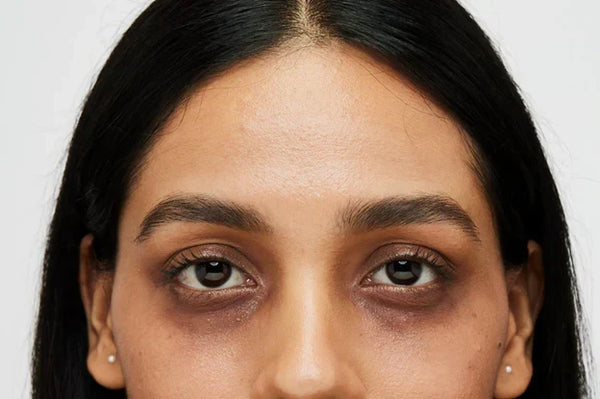
- Dark circles are mostly genetics, natural tone, and anatomy.
- Don't self-supplement for dark circles — iron in particular can be unsafe.
- Suspect a deficiency? See a doctor to test and advise — don't guess.
Scroll through enough skincare content and you'll be told your dark circles are a sign you're low on vitamin C, zinc, or iron — usually followed by a nudge toward a supplement. It's worth pausing on that, because the claim sounds convincing but doesn't hold up the way it's presented. This is an honest look at what the science actually says about nutritional deficiencies and dark circles. It's a companion to our guide on the different types of dark circles.
The Claim — and the Honest Answer
The claim goes like this: because vitamin C, zinc, and iron are important for skin and blood, being deficient in them must cause — or worsen — dark circles. It's a tidy story, and it's everywhere.
Here's the honest answer, and it's worth stating plainly up front: there is currently no solid scientific evidence establishing that a vitamin C, zinc, or iron deficiency causes dark circles. The idea is a hypothesis built on plausible biology — not a demonstrated fact. That distinction matters, especially when the next step being sold to you is a supplement.
"A nutrient mattering for your skin is not the same as a shortfall being the cause of your dark circles. Plausible isn't proven."
Boldpurity Science TeamWhy the Idea Sounds Plausible
The claim isn't pulled from nowhere — each nutrient does have a real role in skin or blood biology, which is what makes the hypothesis tempting. In general terms:
- Vitamin C is an antioxidant and a cofactor the body uses in making collagen — part of what keeps skin resilient. The under-eye skin is very thin, so in principle anything affecting its support could influence how visible the vessels beneath it are.
- Zinc is a trace element involved in many bodily processes, including aspects of skin biology.
- Iron is central to haemoglobin, which carries oxygen in the blood — so it's easy to imagine circulation in the delicate under-eye area being relevant.
These are genuine biological roles. But notice what's happening: the argument reasons from "this nutrient matters" to "a lack of it must be causing your dark circles." That's a leap, not a finding.
What the Evidence Actually Shows
For all three nutrients, the pattern is the same: a plausible mechanism, but the studies to confirm a real-world link largely haven't been done.
The closest thing to direct evidence is a single small study that found iron deficiency in some people with pronounced dark circles. But an association in one group doesn't prove cause — those individuals could have dark circles for the usual reasons (genetics, tone, anatomy) and happen to be iron-deficient too. It's a hint worth researching further, not a conclusion.
The most accurate summary is the honest one: dark circles are multifactorial, the nutritional-deficiency avenue is unproven and still speculative, and for the large majority of people the real drivers are the ones we cover in our types of dark circles guide — thin skin, visible vessels, natural tone, and the shadow of the eye socket.
A Word on Supplements
Because the link is unproven, taking vitamin C, zinc, or iron in the hope of clearing dark circles isn't something to rely on. And it's not risk-free: supplements aren't automatically harmless, and iron in particular can be genuinely unsafe to take without medical supervision — too much is harmful.
If you have reason to think you might be deficient in any nutrient — for reasons that go beyond your under-eye area — the right move is to see a doctor, who can test for it and advise you properly. That's safer and more useful than self-prescribing based on a skincare claim.
For the appearance of dark circles themselves, the dependable approach is the un-glamorous one: gentle skincare habits, decent sleep, daily sun protection, and concealer when you want it — as we cover across our eye-area guides.
Common Myths
There's no solid evidence for this. The idea is plausible because these nutrients matter for skin and blood, but plausible isn't proven — and dark circles are mostly genetics and anatomy.
Fact: Not established — mostly a myth.
No evidence supports supplementing to clear dark circles, and it can be unsafe (iron especially). Suspected deficiencies belong with a doctor, not a guess.
Fact: Don't self-supplement — see a doctor.
A small study noted iron deficiency in some people with dark circles — that's an association, not proof of cause. Correlation and causation aren't the same thing.
Fact: Association isn't causation.
Frequently Asked Questions
- Vissers, M. et al. The roles of vitamin C in skin health. Nutrients (2017).
- Draelos, Z. et al. Zinc and skin health: overview of physiology and pharmacology. Dermatologic Surgery (2006).
- Robbins, P. et al. Iron, oxygen, and the pulmonary circulation. Journal of Applied Physiology (2015).
- Kunjukunju, B. et al. A clinico-epidemiological study of periocular hyperpigmentation. Journal of Evolution of Medical and Dental Sciences (2020).
© 2026 Boldpurity · For educational purposes only · Not to be reproduced without permission.