

Key Research Findings
- Published physiology indicates detoxification in the body is handled mainly by the liver and kidneys — not by the skin
- Published dermatology literature describes skin's primary role as a protective barrier, not an organ that "eliminates toxins" through skincare
- Published commentary indicates "detox" and "detoxifying" are unregulated marketing terms in skincare, not defined scientific claims
- Published research indicates the visible improvements attributed to a "detox" are usually hydration, gentle cleansing, reduced irritation, or barrier recovery
- Published dermatology literature indicates clay and charcoal absorb surface oil and debris — they do not "draw toxins" from inside the body
- Published physiology indicates sweat is largely water and salts; sweating is for temperature control, not skin "detoxification"
- Published research indicates "you'll break out as toxins leave" (a detox purge) is not a supported mechanism; breakouts have other causes
- Published literature indicates gentle, consistent support beats aggressive "detox" routines, which can disrupt the barrier
In This Article
- Where "Detox" Actually Happens in the Body
- Why "Skin Detox" Is Marketing, Not Science
- What You're Really Seeing When a "Detox" Seems to Work
- Clay, Charcoal & "Drawing Out Toxins"
- The Sweat-and-Detox Myth
- The "Detox Purge" Confusion
- The Boldpurity Support-Not-Detox Framework
- What Actually Supports Clear, Healthy-Looking Skin
- Common "Skin Detox" Myths
- Frequently Asked Questions
Where "Detox" Actually Happens in the Body
Published physiology indicates the body has a sophisticated detoxification system — but it lives in the liver and kidneys, which chemically process and excrete waste, not in the skin. Published dermatology literature describes the skin's role as a barrier: keeping water in and irritants, microbes, and UV out. Skin is a wall, not a filter.
Why "Skin Detox" Is Marketing, Not Science
Published commentary indicates "detox" and "detoxifying" are among the most common unregulated buzzwords in wellness and skincare — words that sound scientific but have no fixed, testable meaning on a label. Published research indicates the term borrows the credibility of real medical detoxification (e.g. treating poisoning) and applies it to products that do something entirely different. This is the same pattern seen in our natural and organic marketing myth and chemical-free myth articles.
What You're Really Seeing When a "Detox" Seems to Work
Published research indicates people do sometimes see genuine improvement after a "detox" routine — but not for the reason claimed. What's usually happening: skin is better hydrated, is being cleansed more gently, has had irritating products removed, or the barrier is simply recovering from prior over-use. The benefit is real; the "toxins left my skin" explanation is not.
Published Research on Misattributed Results
Published dermatology literature indicates that when someone strips their routine back to a simple "detox" and skin improves, the improvement typically comes from stopping whatever was irritating it — not from anything being drawn out. Published research indicates this is why a "detox" and simply "using fewer, gentler products" often produce the same result.
Clay, Charcoal & "Drawing Out Toxins"
Published research indicates clay and activated charcoal are genuinely useful for one thing: absorbing excess surface oil and loose debris on the skin. Published dermatology literature is clear, however, that they do not "draw toxins out" from inside the body — they act on the surface only, and cannot reach into the bloodstream or deeper tissue. The "detoxifying" label on a charcoal mask describes marketing, not mechanism.
The Sweat-and-Detox Myth
Published physiology indicates sweat is composed largely of water and salts (with tiny trace amounts of other substances), and that its purpose is temperature regulation — not detoxification. Published research indicates "sweating out toxins" in saunas or workouts is a persistent myth; the liver and kidneys, not sweat glands, clear waste. Excessive reliance on sweating to "detox" the skin can even dehydrate it.
The "Detox Purge" Confusion
Published dermatology literature indicates a common and unhelpful claim is that a "detox" will make you break out first, as "toxins leave the skin." Published research does not support this mechanism. Breakouts during a new routine have other explanations — irritation, comedogenic reactions, or in specific cases genuine retinoid-related purging — none of which involve toxins exiting. Our article on purging vs breakout vs reaction untangles this.
The Boldpurity Support-Not-Detox Framework
Since skin can't be "detoxed," the useful reframe is support. Published dermatology literature points to three genuine levers, which we summarise as a simple named framework.
The Support-Not-Detox Framework
- Remove the irritant — most "detox" wins come from stopping what was over-stressing skin (harsh products, over-exfoliation).
- Support the barrier — gentle cleansing plus hydration lets the skin's own systems work as intended.
- Stay consistent — healthy-looking skin comes from steady support, not periodic "cleanses" or dramatic resets.
This is an educational framework, not a prescriptive regimen or a medical claim. Individual response varies.
What Actually Supports Clear, Healthy-Looking Skin
Instead of a "detox," published dermatology literature commonly discusses supporting the systems skin already has. See also why skincare is not medicine.
Commonly discussed, evidence-aligned steps
- Cleanse gently — remove the day's oil, sweat, and pollution without stripping.
- Hydrate and support the barrier — humectants plus a moisturiser, so skin functions well.
- Simplify if things go wrong — a pared-back routine is the real version of a "reset".
- Protect by day — daily sun protection does more for long-term skin than any "detox".
- Support the body generally — sleep, hydration, and a balanced diet help skin via overall health, not "toxin flushing".
- See a professional for persistent breakouts or concerns rather than reaching for a "detox".
A commonly discussed approach; individual response varies.
The Boldpurity Science Team's view
In our view, "detox" is one of the most quietly misleading words in skincare, because it sells a fantasy — that your skin is dirty on the inside and needs purging. It isn't, and it doesn't. What's frustrating is that "detox" products often do help, which convinces people the story is true; really, they helped because they stopped the harsh routine that was the problem. We'd love to retire the word entirely. Your skin doesn't need a detox, a cleanse, or a reset — it needs to be left alone a bit and supported. That's less dramatic than a "detox," and far more effective.
— An editorial opinion from the Boldpurity Science Team, offered for discussion. Individual response varies.
Common "Skin Detox" Myths
Published physiology indicates detoxification happens in the liver and kidneys, not the skin, and that toxins do not accumulate in skin awaiting release. Published dermatology literature describes skin as a barrier, not a toxin-elimination organ.
Published research indicates clay and charcoal absorb surface oil and debris only — they cannot reach inside the body or bloodstream. Published dermatology literature indicates "detox" here is marketing over a modest surface effect.
Published physiology indicates sweat is mostly water and salts and exists for temperature control, not detoxification. Published research indicates "sweating out toxins" is a myth; over-relying on it can dehydrate skin.
Published research does not support a "detox purge" mechanism. Published dermatology literature attributes early breakouts to irritation, comedogenic reactions, or specific retinoid purging — not toxins exiting.
Published research indicates improvements usually come from better hydration, gentler cleansing, or stopping an irritant — not detoxification. Published dermatology literature indicates "detox" and "simpler, gentler routine" often produce the same result.
Published research does not support "detox" foot pads or patches removing toxins; any dark residue is typically a reaction with moisture, not extracted toxins. Published commentary classifies these as pseudoscience.
Frequently Asked Questions
Explore Boldpurity
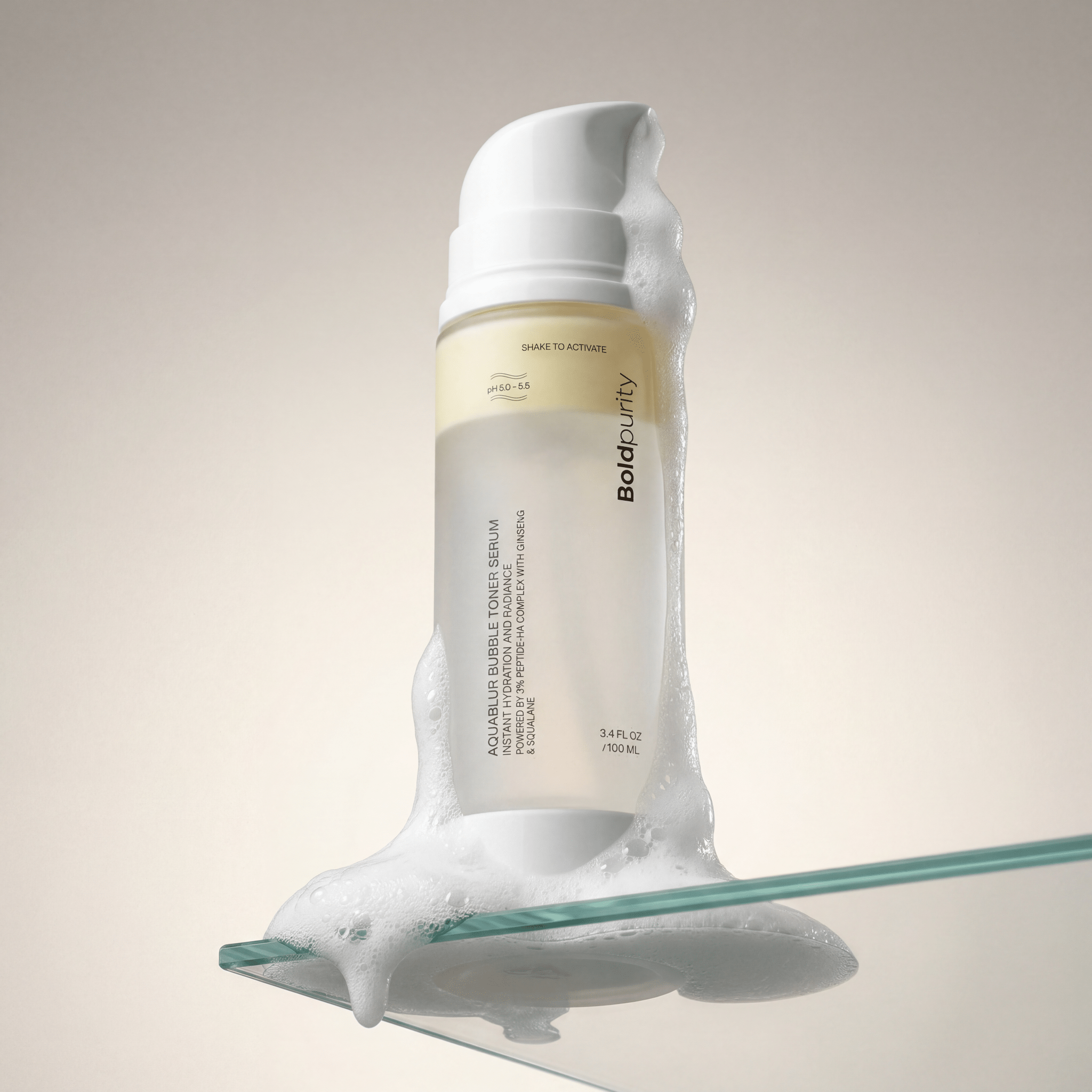
The "reset" skin actually responds to isn't a detox — it's gentle support. AquaBlur™ layers multi-molecular hyaluronic acid, peptides, and squalane to hydrate and support a comfortable barrier, the calm, consistent step that beats any dramatic "cleanse." Supports the appearance of hydrated, comfortable skin; no therapeutic claims.
Discover AquaBlur™References
- Klein, A. V., & Kiat, H. (2015). Detox diets for toxin elimination and weight management: A critical review of the evidence. Journal of Human Nutrition and Dietetics, 28(6), 675–686.
- Cohen, M. (2007). "Detox": Science or sales pitch? Australian Family Physician, 36(12), 1009–1010.
- Genuis, S. J., Birkholz, D., Rodushkin, I., & Beesoon, S. (2011). Blood, urine, and sweat study: Monitoring toxic elements. Archives of Environmental Contamination and Toxicology, 61(2), 344–357.
- Baker, L. B. (2019). Physiology of sweat gland function. Temperature, 6(3), 211–259.
- Proksch, E., Brandner, J. M., & Jensen, J. M. (2008). The skin: An indispensable barrier. Experimental Dermatology, 17(12), 1063–1072.
- Elias, P. M. (2005). Stratum corneum defensive functions: An integrated view. Journal of Investigative Dermatology, 125(2), 183–200.
- Rawlings, A. V., & Harding, C. R. (2004). Moisturization and skin barrier function. Dermatologic Therapy, 17(S1), 43–48.
- Draelos, Z. D. (2018). The science behind skin care: Cleansers. Journal of Cosmetic Dermatology, 17(1), 8–14.
- Moy, R. L., & Levenson, C. (2017). Sandalwood and charcoal in cosmetic formulations: Function and limits. Journal of Clinical and Aesthetic Dermatology, 10(10), 34–39.
- Meyer-Rochow, V. B., & Gross, D. (2019). Detoxification myths in popular culture. Journal of Toxicology and Environmental Health, Part B, 22(5–6), 143–158.
- Del Rosso, J. Q., & Levin, J. (2011). The clinical relevance of maintaining the functional integrity of the stratum corneum. Journal of Clinical and Aesthetic Dermatology, 4(9), 22–42.
- Mukhopadhyay, P. (2011). Cleansers and their role in various dermatological disorders. Indian Journal of Dermatology, 56(1), 2–6.
- Zeichner, J. A. (2016). Acne and the exposome: Environmental drivers of breakouts. Journal of Clinical and Aesthetic Dermatology, 9(11), 44–48.
- Ernst, E. (2009). Alternative detox. British Medical Bulletin, 92(1), 39–44.
- Purnamawati, S., Indrastuti, N., Danarti, R., & Saefudin, T. (2017). The role of moisturizers in addressing various kinds of dermatitis. Clinical Medicine & Research, 15(3–4), 75–87.
- Draelos, Z. D. (2015). Cosmeceuticals: What's real, what's not. Dermatologic Clinics, 33(4), 715–724.
