

Key Research Findings
- Published research indicates sunscreen expires — its UV filters and formulation degrade over time
- Published dermatology literature indicates expired or degraded sunscreen may not provide the labelled level of protection
- Published research indicates under-protection means higher risk of sunburn and cumulative UV damage
- Published guidance indicates sunscreens carry an expiry date and/or a "period after opening" (PAO) symbol to follow
- Published research indicates heat and sun exposure (e.g. leaving it in a hot car or beach bag) can degrade sunscreen faster
- Published dermatology literature indicates changes in texture, smell, colour, or separation can signal a product has gone off
- Published research indicates other skincare actives (such as vitamin C) also degrade, so shelf life applies broadly
- Published guidance indicates when in doubt, replace sunscreen — under-protection isn't worth the risk; individual products vary
In This Article
- Yes, Sunscreen Expires — Here's Why
- Why Expired Sunscreen Is a Real Problem
- How to Tell If Your Sunscreen Has Expired
- How Long Sunscreen Actually Lasts
- Heat & Storage: The Hidden Factor
- Does the Rest of Your Skincare Expire Too?
- The Boldpurity Check-Store-Replace Framework
- How to Store & Use Sunscreen Properly
- Common Sunscreen-Expiry Myths
- Frequently Asked Questions
Yes, Sunscreen Expires — Here's Why
Published research indicates sunscreen is not a "lasts forever" product. Its UV filters and overall formulation are chemically active systems that degrade over time — the actives break down, emulsions can separate, and the product's ability to protect declines. Published dermatology literature and product regulations reflect this by requiring expiry information on sunscreen.
Why Expired Sunscreen Is a Real Problem
Published research indicates that as sunscreen degrades, it may no longer deliver the SPF and broad-spectrum protection on its label. Published dermatology literature indicates this means you can think you're protected while actually being under-protected — leading to sunburn, and over time, cumulative UV damage and pigmentation. For deeper Indian skin, UV also drives the pigmentation many people work hard to avoid, as covered in deeper skin sun protection.
How to Tell If Your Sunscreen Has Expired
Published guidance points to a few checks. First, the expiry / "best before" date printed on the packaging. Second, the PAO (period after opening) symbol — the little open-jar icon with a number like "12M," meaning use within 12 months of opening. Third, your senses: published dermatology literature indicates changes in texture, colour, smell, or separation (a watery or clumpy consistency) suggest the product has degraded, even if the date hasn't passed.
How Long Sunscreen Actually Lasts
Published guidance indicates that, unopened and properly stored, sunscreens are generally formulated to remain stable until their printed expiry date (often a couple of years from manufacture). Once opened, the PAO applies. Published dermatology literature adds a practical point: if you're using sunscreen correctly — a generous amount, every day, reapplied — a bottle shouldn't last long enough to expire in the first place.
Heat & Storage: The Hidden Factor
Published research indicates that heat and sun exposure accelerate sunscreen degradation — and that many people store sunscreen in exactly the wrong places: a hot car, a sunny windowsill, or a beach bag baking in the sun. Published dermatology literature indicates repeated heat exposure can break down the formula before its printed expiry, quietly reducing protection. This is especially relevant in India's climate.
Does the Rest of Your Skincare Expire Too?
Yes — and the same principles apply. Published dermatology literature indicates all cosmetic products have a shelf life and a PAO, and that some actives degrade notably: vitamin C, for instance, is well known to oxidise and lose potency (often turning yellow/brown). Published research indicates expired serums and moisturisers may be less effective and, occasionally, more likely to irritate — so checking dates and PAO across your routine is a sensible habit.
The Boldpurity Check-Store-Replace Framework
Published guidance points to three simple habits. We summarise them as a named framework.
The Check–Store–Replace Framework
- Check — note the expiry date and PAO, and watch for changes in texture, colour, or smell.
- Store — keep sunscreen (and skincare) cool and out of direct sun and heat.
- Replace — when it's expired, past its PAO, heat-damaged, or clearly changed — and when in doubt, especially for sunscreen.
This is an educational framework, not a prescriptive regimen. Always follow your individual product's instructions.
How to Store & Use Sunscreen Properly
Published guidance and dermatology literature commonly discuss the following. See also what sunscreen should I use.
Commonly discussed steps
- Check the date and PAO when you buy and before a big sun day.
- Store it cool and shaded — not in a hot car, sunny sill, or exposed beach bag.
- Use enough, daily — generous, regular use means a bottle won't sit around long enough to expire.
- Don't rely on old sunscreen for real sun exposure — replace if unsure.
- Note the opening date on the tube to track the PAO.
- Bin it if it's changed — separated, discoloured, or off-smelling means replace.
A commonly discussed approach; always follow your product's own guidance.
The Boldpurity Science Team's view
Most "does it expire?" skincare questions are low-stakes — an old moisturiser is usually just less nice to use. Sunscreen is the exception, and in our view it's the one product where we'd tell people to be genuinely strict. An expired or car-baked sunscreen gives you the confidence of protection without the protection, which is arguably worse than nothing. The good news is there's a built-in fix: if you're using sunscreen the way you're supposed to — every day, generously — you'll finish the bottle long before it expires. So if you keep finding old, half-used sunscreens, the expiry date isn't really your problem; the amount you're using is.
— An editorial opinion from the Boldpurity Science Team, offered for discussion. Individual products vary.
Common Sunscreen-Expiry Myths
Published research indicates UV filters and formulation genuinely degrade over time, reducing protection. Published dermatology literature indicates the expiry date reflects real chemistry, not a formality.
Published dermatology literature indicates degraded sunscreen may not deliver the labelled protection, and you can't tell by how much. Published research indicates relying on it risks real under-protection and sunburn.
Published research indicates heat and sun exposure can degrade sunscreen before its printed date. Published dermatology literature indicates a heat-exposed product may be compromised regardless of the date.
Published guidance indicates the PAO (period after opening) also matters — an opened product has a limited useful life. Published dermatology literature indicates a long-opened sunscreen may be past its best even with a future expiry date.
Published dermatology literature indicates all cosmetics have a shelf life and PAO, and actives like vitamin C degrade. Published research indicates expired products can be less effective or more irritating.
Published dermatology literature indicates correct use — generous, daily, reapplied — means a bottle is used up well before expiry. Published research indicates a long-lasting bottle usually signals under-application, not efficiency.
Frequently Asked Questions
Explore Boldpurity
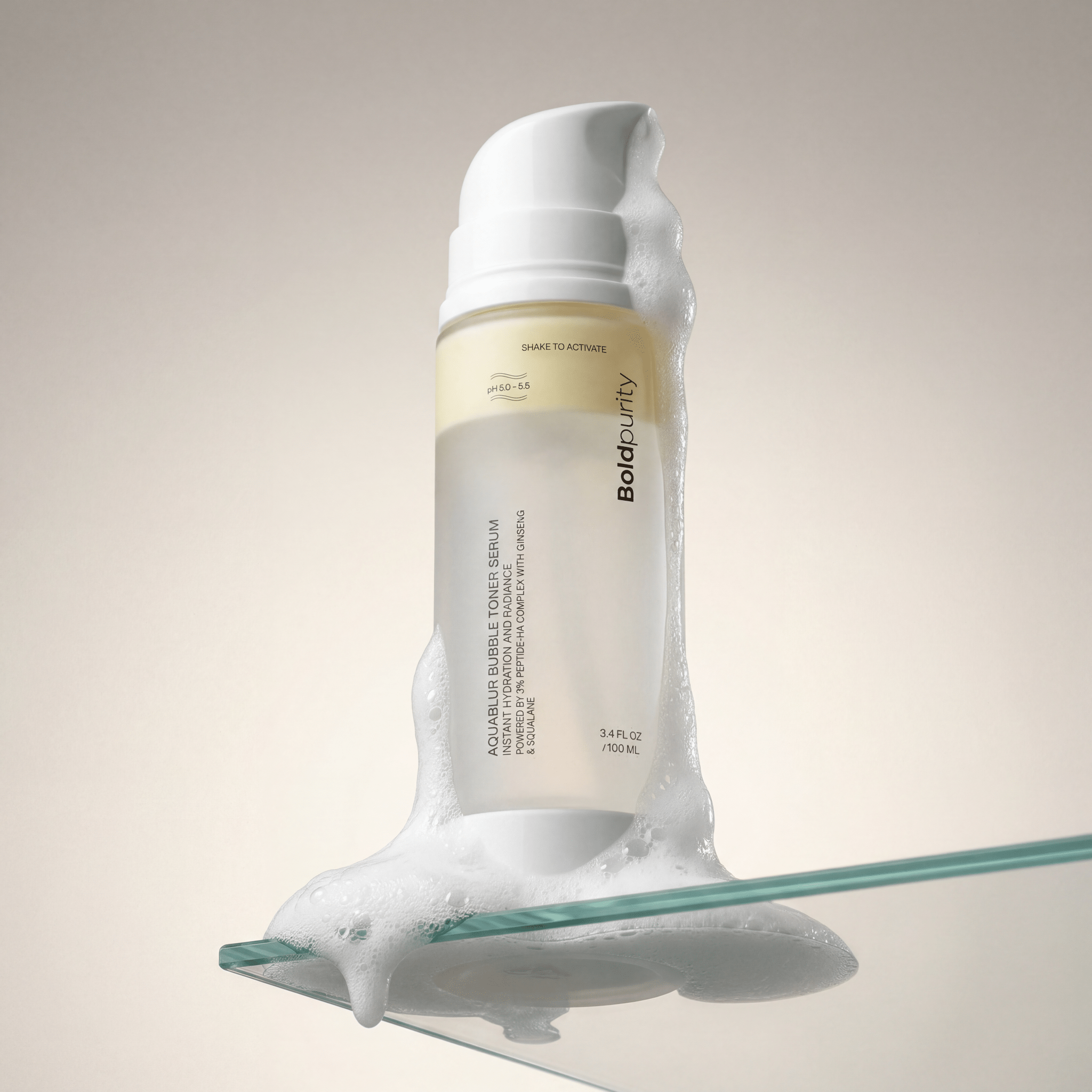
The same check-the-date, store-it-cool habit applies to every serum, including AquaBlur™ — a hydrating toner-serum (hyaluronic acid, peptides, squalane) that supports the appearance of hydrated, comfortable skin. Note its PAO and keep it out of heat so it performs as intended. (Sunscreen is a separate step — this serum is not a sunscreen.) Supports appearance only; no therapeutic claims.
Discover AquaBlur™References
- Gaspar, L. R., & Maia Campos, P. M. B. G. (2006). Evaluation of the photostability of different UV filter combinations in a sunscreen. International Journal of Pharmaceutics, 307(2), 123–128.
- Serpone, N., Dondi, D., & Albini, A. (2007). Inorganic and organic UV filters: Their role and efficacy in sunscreens. Inorganica Chimica Acta, 360(3), 794–802.
- Kockler, J., Oelgemöller, M., Robertson, S., & Glass, B. D. (2012). Photostability of sunscreens. Journal of Photochemistry and Photobiology C, 13(1), 91–110.
- Couteau, C., et al. (2012). Study of the photostability of 18 sunscreens. International Journal of Pharmaceutics, 431(1–2), 197–201.
- US Food and Drug Administration. (2021). Sunscreen: How to help protect your skin from the sun (expiry and storage guidance).
- Sambandan, D. R., & Ratner, D. (2011). Sunscreens: An overview and update. Journal of the American Academy of Dermatology, 64(4), 748–758.
- Wang, S. Q., & Lim, H. W. (2016). Principles and Practice of Photoprotection. Springer.
- Diffey, B. L. (2018). Sunscreens and UV exposure. Photodermatology, Photoimmunology & Photomedicine, 34(1), 78–80.
- Kaimal, S., & Abraham, A. (2011). Sunscreens. Indian Journal of Dermatology, Venereology and Leprology, 77(2), 238–243.
- Osterwalder, U., & Herzog, B. (2009). Sun protection factors: World wide confusion. British Journal of Dermatology, 161(s3), 13–24.
- Pullar, J. M., Carr, A. C., & Vissers, M. C. M. (2017). The roles of vitamin C in skin health. Nutrients, 9(8), 866.
- Pinnell, S. R., et al. (2001). Topical L-ascorbic acid: Percutaneous absorption studies. Dermatologic Surgery, 27(2), 137–142.
- Lin, F. H., et al. (2005). Ferulic acid stabilizes a solution of vitamins C and E. Journal of Investigative Dermatology, 125(4), 826–832.
- European Commission. (2013). Regulation (EC) No 1223/2009 on cosmetic products (PAO labelling).
- Alexis, A. F., & Blackcloud, P. (2013). Photoprotection in specific populations. Journal of the American Academy of Dermatology, 69(2), S25–S31.
- Draelos, Z. D. (2015). Cosmeceuticals: What's real, what's not. Dermatologic Clinics, 33(4), 715–724.
