

Key Research Findings
- Published research indicates air conditioning lowers indoor humidity, and low-humidity air increases water loss from the skin surface
- Published dermatology literature associates prolonged low-humidity exposure with skin feeling tight, dehydrated, rough, or flaky
- Published research indicates AC dryness is a reversible skin state, not permanent damage
- Published dermatology literature indicates already-dry, mature, or sensitive skin, and long AC hours, feel the effect most
- Published research indicates a healthy skin barrier limits how much dry air affects skin
- Published dermatology literature indicates humectant hydration plus a moisturiser counters AC-related dryness effectively
- Published research indicates the mechanism is the same as dry cabin air on flights — low humidity, not the cold itself
- Published literature emphasises individual response varies; simple habits make AC environments comfortable for skin
In This Article
- How AC Changes the Air Around You
- How Dry Air Affects Your Skin
- Dehydrated, Not Damaged: What AC Actually Causes
- Who Feels It Most
- The "AC Permanently Ruins Your Skin" Myth
- What Helps vs What Doesn't
- The Boldpurity Humidify-Hydrate-Seal Framework
- How to Protect Skin in AC
- Common AC & Skin Myths
- Frequently Asked Questions
How AC Changes the Air Around You
Published research indicates air conditioning cools air partly by removing moisture from it — which is why AC units produce condensation and drip water outside. The result is that air-conditioned rooms tend to have lower humidity than the outdoor air, especially over long periods. Published dermatology literature indicates it is this drop in ambient humidity, not the cool temperature itself, that matters most for skin.
How Dry Air Affects Your Skin
Published research indicates that in low-humidity air, water evaporates faster from the skin surface — increasing transepidermal water loss. Published dermatology literature indicates that when this outpaces the skin's ability to hold water, the surface can feel tight, look dull, and become rough or flaky. A healthy skin barrier slows this loss; a compromised one loses water faster.
Published Research on Low Humidity and Skin
Published dermatology literature indicates that repeated or prolonged exposure to low-humidity environments can measurably reduce skin surface hydration and, over time, stress the barrier. Published research indicates this is the same basic mechanism that makes skin feel dry on long flights — it's the dry cabin air, not the altitude, and AC rooms behave similarly. See our article on why skin feels drier on a plane.
Dehydrated, Not Damaged: What AC Actually Causes
Published dermatology literature draws a helpful distinction: AC typically leaves skin dehydrated (temporarily low in water) rather than permanently damaged. Published research indicates dehydration is a changeable state that responds quickly to hydration and barrier support — unlike a fixed skin type. This mirrors the point in our articles on dull vs dehydrated skin and skin types vs conditions.
Who Feels It Most
Published dermatology literature indicates the drying effect of AC is felt most by people with already-dry, mature, or sensitive skin, those with a compromised barrier, and anyone spending long hours in air-conditioned offices, homes, or cars — common across urban India. Published research indicates oily skin is generally more resilient to low humidity but is not immune, and can still feel dehydrated on the surface even while producing oil.
The "AC Permanently Ruins Your Skin" Myth
Published dermatology literature does not support the idea that air conditioning causes permanent skin damage or premature ageing on its own. Published research indicates the main effect is temporary dehydration and, if left unmanaged over long periods, ongoing barrier stress — both of which improve when you rehydrate and support the barrier. AC is a manageable environmental factor, not a skin-destroyer.
What Helps vs What Doesn't
| Approach | Does it help AC dryness? |
|---|---|
| Humectant hydration + moisturiser | Yes — replaces and seals in water |
| A room humidifier | Yes — raises ambient humidity |
| Facial mist alone (no sealing) | Limited — can even worsen if it evaporates unsealed |
| Drinking more water alone | Limited — surface dryness is mostly a barrier/topical issue |
| Harsh cleansing / over-exfoliating | No — worsens barrier and dryness |
| Avoiding AC entirely | Rarely practical — manage instead |
The Boldpurity Humidify-Hydrate-Seal Framework
Published dermatology literature points to three levers for AC-dried skin. We summarise them as a named framework.
The Humidify–Hydrate–Seal Framework
- Humidify — where you can, raise the humidity around you (a small humidifier, plants, or not over-cooling the room).
- Hydrate — apply humectant hydration to replace water at the skin surface.
- Seal — follow with a moisturiser to limit water loss into the dry air.
This is an educational framework reflecting commonly discussed practice, not a prescriptive regimen. Individual response varies.
How to Protect Skin in AC
Published dermatology literature commonly discusses the following for comfortable skin in air-conditioned environments. See also how hydration works.
Commonly discussed steps
- Hydrate and seal, morning and evening — humectant on damp skin, then a moisturiser.
- Reapply lightweight hydration mid-day if you're in AC for long hours (then seal).
- Consider a small humidifier at your desk or bedside to offset dry air.
- Don't over-cleanse — harsh washing compounds AC dryness.
- Mind combination skin — you can be oily and dehydrated; hydrate without heavy occlusion if oily.
- Keep daily sun protection — indoor light and stepping outside still count.
A commonly discussed approach; individual response varies.
The Boldpurity Science Team's view
Living and working in India, most of us spend hours a day in AC — and then blame our products when our skin feels tight by evening. In our view, AC dryness is one of the most under-recognised, easily-fixed skin issues around. It's not that your serum stopped working; it's that you're sitting in low-humidity air for eight hours pulling water out of your skin. The fix isn't dramatic — hydrate, seal, maybe a little desk humidifier — and the "AC is destroying my skin" panic is overblown. Manage the dry air and AC becomes a comfort, not a skin problem.
— An editorial opinion from the Boldpurity Science Team, offered for discussion. Individual response varies.
Common AC & Skin Myths
Published dermatology literature does not support permanent damage from AC alone; the main effect is temporary dehydration and, if unmanaged, barrier stress. Published research indicates both improve with hydration and barrier support.
Published research indicates the drying effect comes mainly from AC lowering the air's humidity, not from the cool temperature itself. Published dermatology literature indicates low humidity increases water loss from skin.
Published dermatology literature indicates oil and water are different; oily skin can still be surface-dehydrated in dry AC air. Published research indicates a shiny T-zone doesn't mean the skin surface is well hydrated.
Published dermatology literature indicates that misting water in dry air can backfire if unsealed, as evaporation can pull surface water away. Published research indicates a mist should be followed by a moisturiser, not used alone.
Published dermatology literature indicates surface dryness is mainly a barrier and topical-hydration issue, not a fluid-intake one. Published research indicates topical hydration and sealing address AC dryness more directly than drinking extra water.
Published dermatology literature indicates AC dryness is manageable with simple habits, so avoiding AC is rarely necessary. Published research indicates hydration, sealing, and humidifying let you stay comfortable in AC.
Frequently Asked Questions
Explore Boldpurity
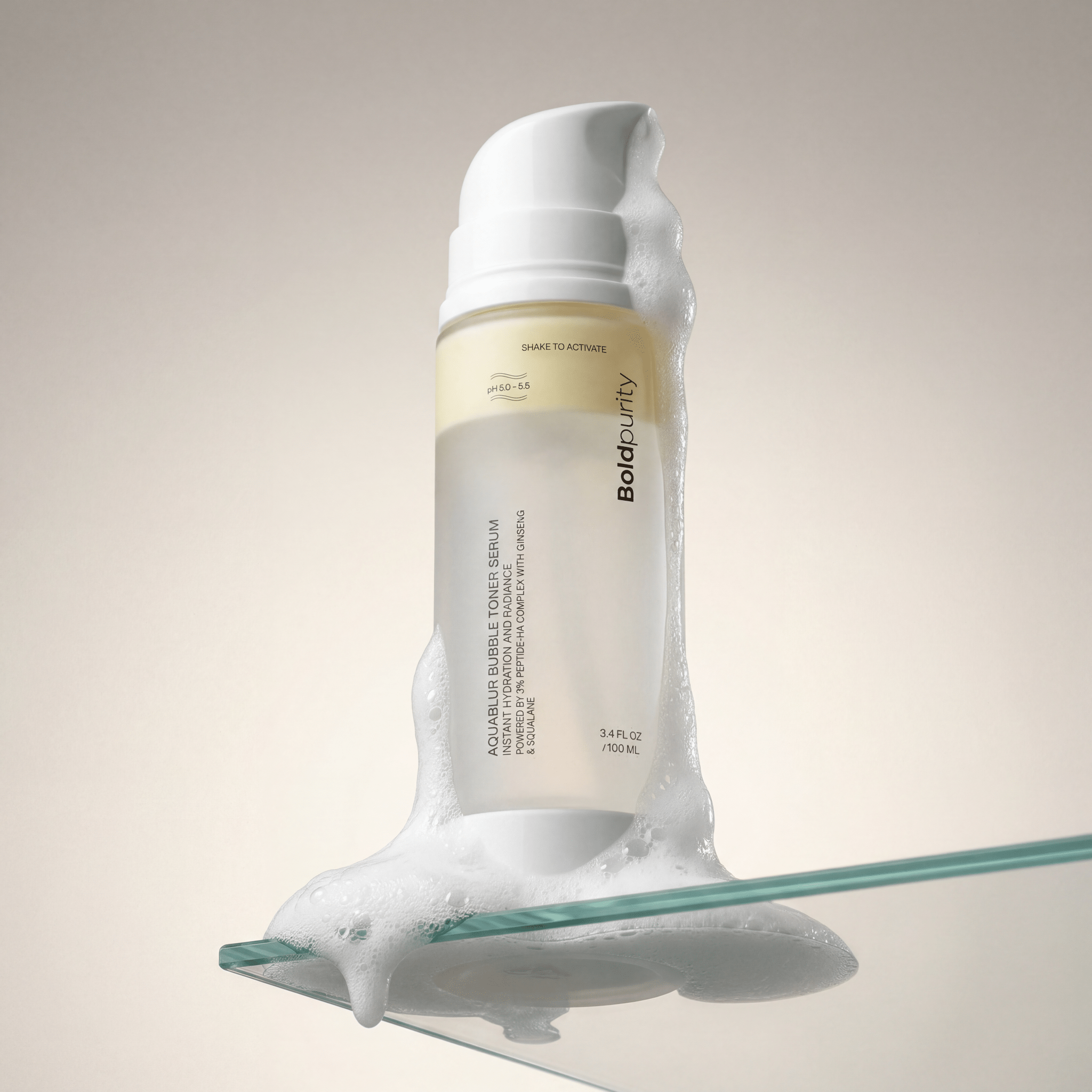
For long hours in AC, AquaBlur™ is a lightweight way to put water back into the skin — multi-molecular hyaluronic acid, peptides, and squalane — comfortable enough for combination and oily skin, and easy to layer under a moisturiser to seal it in. Follow with a moisturiser in very dry air. Supports the appearance of hydrated, comfortable skin; no therapeutic claims.
Discover AquaBlur™References
- Engebretsen, K. A., Johansen, J. D., Kezic, S., et al. (2016). The effect of environmental humidity and temperature on skin barrier function and dermatitis. Journal of the European Academy of Dermatology and Venereology, 30(2), 223–249.
- Rogers, J., Harding, C., Mayo, A., et al. (1996). Stratum corneum lipids: The effect of ageing and the seasons. Archives of Dermatological Research, 288(12), 765–770.
- Sato, J., Yanai, M., Hirao, T., & Denda, M. (2002). Water content and thickness of the stratum corneum contribute to skin surface morphology. Archives of Dermatological Research, 294(1–2), 71–75.
- Goad, N., & Gawkrodger, D. J. (2016). Ambient humidity and the skin: The impact of air humidity in healthy and diseased states. Journal of the European Academy of Dermatology and Venereology, 30(8), 1285–1294.
- Verdier-Sévrain, S., & Bonté, F. (2007). Skin hydration: A review on its molecular mechanisms. Journal of Cosmetic Dermatology, 6(2), 75–82.
- Rawlings, A. V., & Harding, C. R. (2004). Moisturization and skin barrier function. Dermatologic Therapy, 17(S1), 43–48.
- Denda, M., Sato, J., Tsuchiya, T., et al. (1998). Low humidity stimulates epidermal DNA synthesis and amplifies the hyperproliferative response to barrier disruption. Journal of Investigative Dermatology, 111(5), 873–878.
- Del Rosso, J. Q., & Levin, J. (2011). The clinical relevance of maintaining the functional integrity of the stratum corneum. Journal of Clinical and Aesthetic Dermatology, 4(9), 22–42.
- Byrne, A. J. (2010). Bioengineering and subjective approaches to the clinical evaluation of dry skin. International Journal of Cosmetic Science, 32(6), 410–421.
- Fluhr, J. W., Darlenski, R., & Surber, C. (2008). Glycerol and the skin. British Journal of Dermatology, 159(1), 23–34.
- Purnamawati, S., Indrastuti, N., Danarti, R., & Saefudin, T. (2017). The role of moisturizers in addressing various kinds of dermatitis. Clinical Medicine & Research, 15(3–4), 75–87.
- Draelos, Z. D. (2018). The science behind skin care: Moisturizers. Journal of Cosmetic Dermatology, 17(2), 138–144.
- Kam. E., et al. (2019). Indoor environment and skin barrier: A review. Indian Journal of Dermatology, 64(5), 353–360.
- Spada, F., Barnes, T. M., & Greive, K. A. (2018). Skin hydration is significantly increased by a cream formulated to mimic the skin's own natural moisturizing systems. Clinical, Cosmetic and Investigational Dermatology, 11, 491–497.
- Elias, P. M. (2005). Stratum corneum defensive functions: An integrated view. Journal of Investigative Dermatology, 125(2), 183–200.
- Farage, M. A., Miller, K. W., Elsner, P., & Maibach, H. I. (2008). Intrinsic and extrinsic factors in skin ageing. International Journal of Cosmetic Science, 30(2), 87–95.
